
Part 4: Selling A Loved One's Home: What Needs to Happen Before an Inherited Home Is Sold?
What Happens Before an Inherited Home Is Sold?
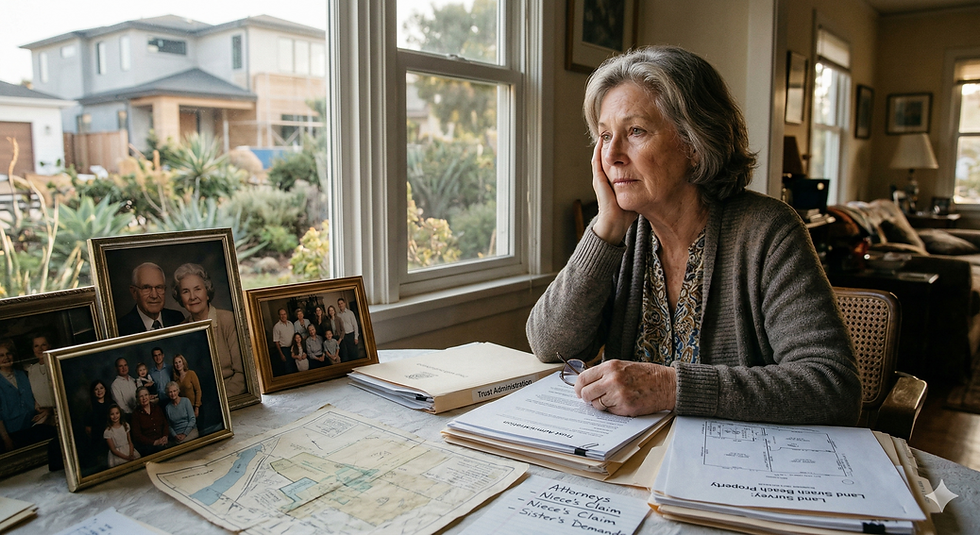
When a loved one dies and leaves behind a home, the grief the family feels is often only the beginning. For the one person expected to sell that home, the loss is almost immediately followed by dread, because along with the sadness comes a quiet but overwhelming awareness that they will now be the one expected to step in and handle everything left behind.

They will be the one left to sort through the belongings, manage unfamiliar paperwork, make legal and financial decisions they may not fully understand, deal with the condition of the home, and manage the family dynamics that so often rise to the surface after a loved one has passed away.
In many families, this responsibility is handed to one person almost like a compliment. “You’re the strong one.” “You’re the one who can handle it.” But in reality, it may become one of the heaviest burdens they will ever carry.
In my experience, the sale of a loved one’s home becomes much easier to understand when families realize that five conditions are already shaping the sale before the property ever goes on the market: (1) the condition of the home, (2) the financial obligations tied to it, (3) the legal authority to sell, (4) the level of family cooperation, and (5) the freedom of the decision-maker to actually move the sale forward.
These five conditions exist in every home sale, but they often become far more difficult when a family member is responsible for selling a loved one’s home and everyone else is depending on that person to carry the responsibility smoothly.
It helps to recognize that these conditions are already in place before the person responsible for the sale is ready to move forward. When those conditions are unclear, complicated, or confusing, the trustee, executor, or family decision-maker can quickly become overwhelmed. Frustration, surprise, and anger begin to build, and the sale can start to feel impossible and painful.
Other family members may not understand why the home cannot be listed right away, why money may need to be spent before it can be sold, or why a sale that looked simple from the outside is suddenly delayed and more difficult than anyone expected.
When several of these conditions are difficult at the same time, the person responsible for the sale can feel overwhelmed before the home ever goes on the market.
Claudia’s story touched all five.
This Was Never Just About Repairs. It Was About Burden, Family, and Letting Go
Claudia had been told as a young woman that one day she would be the one to sell her parents’ home. What may have sounded flattering at the time became a burden she carried for years. Long before she understood what it would actually require, she lived with the quiet awareness that when the time came, she would be expected to step in and carry it forward.
Her father had died years earlier. Her mother had recently passed. And now the responsibility everyone had quietly placed on her for years was no longer somewhere in the future. It was here.
From the beginning, Claudia told me she felt burdened by the responsibility of selling the home. She was not comfortable being the decision-maker, and she felt the full weight of it. That made sense, because this was never going to be a simple matter of putting the home on the market. Nothing about the house was ready. The family was not ready either. This was not going to be an easy sale.
When Family Is Still Living in the Home, the Sale Gets More Complicated
Two of Claudia’s sisters were still living in the home, along with some of their grandchildren. They were not hostile, but they were also not preparing to move so the home could be sold. They had been living there rent-free for years and were not financially able to contribute to the preparation of the property. Instead of packing up, they were continuing to accumulate belongings that would eventually need to be moved somewhere else.
They had lived together in the home for years. Now the sale would not only force them to leave the family home, it would also separate them from one another. In many ways, they were acting as if the house was not really going to be sold, especially since neither of them had the financial means to move or rent.
This made one of the conditions even more painful for Claudia. She was not being asked to clear out a vacant property. She was being forced to move her own sisters and their grandchildren out of the family home. This was the house where they had all been raised, where decades of memories and family life had taken place.
On top of grieving the loss of her mother, Claudia carried the enormous guilt of being the one who had to force her sisters to leave the only security they had.
She was the one who had to face what the house needed in order to be sold, what the finances would or would not allow, and what her legal responsibility required, even though she did not feel comfortable with it.
At the same time, the family was emotionally resisting the sale, and every delay added more pressure to a situation she already felt overwhelmed by.
The House Was Falling Apart, and So Was the Hope of an Easy Sale
The home itself had potential, at least on paper. It sat on a large lot in an area where a buyer might eventually tear it down and build something more valuable. It even had a partial view that could have been expanded if the property were redeveloped.
But that was not the reality Claudia was facing.
The reality was that the home had been altered over time, maintained in a rough do-it-yourself way, and neglected for years. It had been in serious decline long before her mother died. A lack of money had prevented much-needed repairs, and now Claudia was left to face the consequences of years of deferred maintenance all at once.
A bedroom and bathroom had been added to the house years earlier, finished without permits at a time when they were not required. Now the roof over that section was beginning to slope. The backyard had been ignored, and old cars had been sitting in front of the home for years.
The house was full of furniture. Twenty-five large plastic storage containers lined two walls of the primary bedroom, waiting to be moved to a new location, while other belongings were stuffed into drawers, piled on chairs, and packed into overfilled closets. No one had even started preparing to move out when I first saw the home.
The kitchen was not only old. It was failing. The sink was leaking, and only two of the four burners on the undersized stove worked.
That is what makes this kind of transaction so emotionally exhausting and complicated. Any executor, trustee, or family decision-maker facing a home like this can quickly become overwhelmed by the amount of work and pressure it takes to move the sale all the way to the finish.
After I met the sisters and saw the condition of the home, I brought in my contractor to inspect the property and recommend repairs and improvements that might increase the sale price. Unfortunately, the recommendations were extensive, and Claudia’s limited budget would not come close to covering them.
Then came another blow.
When the contractor climbed under the home to inspect the plumbing, he discovered black mold beneath the hallway bathroom. Claudia’s sister explained that several years earlier there had been a leak in the tub, and one of the brothers had handled the repair. But no plumber had ever checked the work, and the leak had continued inside the walls, allowing mold to spread through three sections of the bathroom.
The bathtub needed to be replaced. Three of the walls behind the wallboard were wet and moldy. The sink, toilet, plumbing, and flooring all needed to be replaced.
This was a major blow to Claudia. She was shocked by the extent of the damage because nothing in the bathroom had made the problem obvious. There was no strong smell, and it had not shown up from above. It was only revealed once someone looked underneath the home.
Claudia now had an urgent decision to make. Should she pay for the bathroom repair, or get her sisters and their families out quickly and sell the home without doing the work? The cost was about $3,500. It was a fair price, but it was still money coming out of her limited budget.
I watched Claudia agonize over what to do. She wanted to give her sisters the most money possible from the sale. At the same time, the deferred maintenance was so significant that she had to face a difficult question. Was this one repair worth doing, or was it smarter to stop putting money into a property with far bigger problems?
She approved the bathroom work, even though it strained the budget, because the sisters were still living there and the bathroom needed to be safe and usable.
Then, just after the repair was completed, COVID hit. That brought another layer of delay to the sale. One of the sisters became ill, which limited access to the home for several weeks. Even after she recovered, the process of finding new places to live took time, especially since both sisters needed affordable housing for themselves and their grandchildren with very limited income.
Every time I went back to the property, there was something else broken, leaking, or in disrepair. I could feel Claudia’s frustration as she tried to get the home on the market. Between COVID, move-out delays, and ongoing costs, the sale was taking far longer than expected, and she carried the weight of that every day.
The Real Question Was No Longer How Much More Money the House Could Bring
After several discussions, Claudia understood that she needed to sell the property as-is, without further repairs, and as quickly as possible. She also had to begin pushing her sisters to find new places to live and start moving their belongings out.
That process took time. The sisters were going to have to separate, even though they relied on each other to help care for the grandchildren. They were very close, and it was painful for them to face that reality and begin moving toward leaving the home.
The real question was no longer how much more money the home could bring. It was how fast we could get it sold before something else broke or another delay reduced its value. Every day off the market meant the home was losing what little value could still be preserved for the family.
The home had so many structural and condition problems that it was never going to compete as a polished retail sale. The yard needed significant work, the old cars needed to be removed, and the home simply did not show well. Buyers were quickly turned off.
This was the kind of property that attracted cash buyers. It was a true fixer. Developers who might tear it down and rebuild did not appear. Instead, investors came in calculating repair costs and making heavily discounted offers that felt painfully low to Claudia. She was slowly coming to grips with the reality that the condition of the home was directly impacting how much money the family would receive.
That reality was deeply painful for Claudia. To the family, this was not just a rundown property. It was the family home. It held memories of childhood, holidays, and decades of shared life. So when buyers came in with low offers and treated it like a project or a piece of land, it felt insulting. Claudia experienced it as another blow in a responsibility she had never wanted to carry in the first place.
Cash buyers are often lined up waiting for opportunities like this. Another delay occurred when the first buyer failed to perform and could not produce the cash to close escrow. The good news was that the same day we cancelled that escrow, we were able to secure a second cash buyer who closed within ten days.
The problem was not a lack of interest. The problem was that the kind of buyer this home attracted would never value it the way the family did.
What made it even harder was that Claudia felt guilty from every direction. She felt guilty about moving her sisters out, about the delays, about not getting more money for the home, and about being the one who had to push the entire process forward.
She was trying to be fair, responsible, and compassionate all at the same time, but the house, the family, and the market were all working against ease.
Another hard truth is that families do not always understand as-is sales. Cash buyers are often the right buyers for distressed homes, but they are also the most aggressive negotiators. They are looking at repair costs, resale margins, risk, and profit. Families, on the other hand, are looking at memories, burden, fairness, and loss. Those two viewpoints often collide.
For Claudia, every delay felt like another arrow. Every setback hurt. She had grown up in that house. She remembered what it meant to the family. And now she was the one having to sell it out from under sisters who were not really in a position to support themselves independently. In the end, each of them rented a room from another family member so they could finally move out.
What This Story Reveals About Selling a Loved One’s Home
What has stayed with me about Claudia’s story is not simply that the home sold for less. It is that she had to carry so much before it could even be sold at all. She was grieving. She felt guilty about pushing her sisters out of the home, especially because they did not have the money to move or create new living arrangements together. She had been burdened by this responsibility long before the home ever had to be sold. She was responsible for conditions she did not create, decisions she did not want, and consequences that hurt people she loved. And yet she kept going.
This is what many people do not see when they look at an inherited home from the outside. They may see a property. They may see a price. They may see repairs, delays, or legal steps. But the person responsible for the sale is often carrying far more than that. They are carrying family history, grief, pressure, guilt, conflict, and the exhausting reality of making hard decisions when there is no perfect answer.
You Do Not Have to Force a Perfect Outcome
If this kind of sale feels overwhelming, that is because it is. When a home has been declining for years, the money is limited, family members are not ready, repairs keep showing up, and delays keep piling on, the person carrying the responsibility can feel crushed by it all.
Claudia’s story is a painful example of that. But it also shows something important. Even when the sale is emotionally exhausting, disappointing, and far more difficult than anyone hoped, it can still be moved through. One hard decision at a time.
Need Help Selling a Loved One’s Home?
If you are the person carrying the responsibility of selling a parent’s home, an inherited home, or a property tied to grief, family conflict, deferred maintenance, or difficult decisions, you do not have to figure it all out alone.
I help families and decision-makers move through the emotional and practical side of selling a loved one’s home in San Diego County. If you need guidance, support, or a steady plan for what comes next, reach out to me.
Continue Reading the Series
This article is part of my series on the real stories behind selling a loved one’s home.
Read the earlier posts in the series to better understand what families often face before, during, and after a home sale involving death, grief, legal authority, repairs, delay, and family strain.
Read all 8 Stories from my book, Selling a Loved One's Home.
If you are the person responsible for selling a loved one’s home after a death, you do ot have to figure out everything alone.
Download my free book, Selling a Loved One’s Home, along with additional guides, articles, and resources designed to help families navigate the emotional, financial and practical challenges that often arise during the sale process.
Whether you are dealing with probate, trust administration, family conflict, deferred maintenance, downsizing or simply trying to understand what comes next, these free resources can help you move forward with greater confidence and clarity. Selling a Loved One’s Home: What to Know, What to Expect, How to Move through the Heartbreak, Decisions and Details After a Death
Connect with Me
Dr. Deena Stacer
This Doctor Makes House Calls!
Call or Text: 858-229-8072
Email: Doc@DeenaStacer.com
Stacer Realty
DRE # 00703471

Comments